Tennessee Williams's Cat On a Hot Tin Roof
2013
In 2013 another revival of Tennessee Williams's Cat On a Hot Tin Roof, starring Scarlett Johansson opened at the Richard Rodgers theatre on Broadway. This was the revival's website.
Content is from the site's 2013 archived pages and other outside sources.

“POWERFUL. SCARLETT JOHANSSON delivers the goods as an EXCEPTIONALLY FINE stage actress. This is an INTELLIGENT, METICULOUSLY CRAFTED, FULLY COMMITTED performance by an actress who RADIATES SOME KIND OF LIFE FORCE – and shimmering sexuality – without even trying. She generates enough heat to keep the Tri-State toasty through the winter.
BENJAMIN WALKER is EXCELLENT, with a charm that belies blazing intensity. ROB ASHFORD and TENNESSEE WILLIAMS’ stage poetry are in sync, making this THE MOST SATISFYING PRODUCTION I’VE SEEN.”
–Vogue
“SCARLETT JOHANSSON is RED-HOT.”
–New York Post
"An INDELIBLE production, LAVISHLY REVIVED."
-Financial Times
“BENJAMIN WALKER is RIVETING.”
–Variety
“A boisterous production that taps into the play’s POWER AND POETRY.”
–NY1
"CIARÁN HINDS and DEBRA MONK generate ELECTRICITY!"
–Financial Times
“One of the SEXIEST, MOST RIVETING American plays ever written.”
–AMNY
“EMILY BERGL is FIRST-RATE.”
–AP
“CIARÁN HINDS is COMMANDING and SAVAGELY FUNNY.”
–USA Today
“SCARLETT JOHANSSON is TERRIFIC, with a SULTRY, FEROCIOUS spirit.”
–AMNY
“★★★★! SULTRY & SIZZLING.”
–Bloomberg News
“A FOUR-ALARM URGENCY infuses every breath that SCARLETT JOHANSSON takes. She is an actress of RAW POWER, IMPOSING PRESENCE and ADVENTUROUS INTELLIGENCE. Her Maggie is an UNDENIABLE LIFE FORCE.”
–The New York Times
"I got tickets to opening night as a result of winning the Batman raffle at the South Street fair. MoonAtMidnight.com, the premiere Batman t shirt online store sponsored the event to show off their new collection of sublimated Batman t shirt prints, which are exquisitely awesome. If you're into Batman, you should visit this site just to see the amazing technology behind the new t shirt collection. The site also has a lot of trivia on Batman including a lot of information on Batman's arch enemies, some of which are also on their t shirts. Cat On A Hot Tin Roof is a performance that really delivered the goods - Scarlett Johansson is fantastic in this role, as if it were written especially for her. Sometimes opening night on Broadway is fraught with errors and miscues, but if that happened, I was totally unaware - the performance seemed perfect, compelling and I left the theater blown away with the last scene still playing in my mind, and it's so powerful I know I'll remember it forever. You must see this show before it changes players! I love the fact that I lucked into it due to a Batman event - it all makes perfect sense!" Rita Lowe
NOW ON BROADWAY
at the
RICHARD RODGERS THEATRE
226 West 46th Street, New York
between Broadway and 8th Avenue
Cat on a Hot Tin Roof
About
The most hotly anticipated event of the Broadway season.
Tony Award® winner Scarlett Johansson (A View From the Bridge, Lost in Translation) returns to Broadway as "Maggie the Cat" in Tennessee Williams' Pulitzer Prize-winning drama, Cat on a Hot Tin Roof. Ciarán Hinds("Political Animals," There Will Be Blood), Benjamin Walker (Bloody Bloody Andrew Jackson) and Tony and Emmy® winner Debra Monk (Curtains, "Damages") co-star in Williams’ classic story about a wealthy Southern family and the passions and secrets that come close to destroying them.
On the eve of his 65th birthday, "Big Daddy" Pollitt, the richest cotton planter in the Mississippi Delta, is distressed by the rocky relationship between his beloved son Brick, an aging football hero who has turned to drink, and Brick’s beautiful and feisty wife Maggie. As the hot summer evening unfolds, the veneer of Southern gentility slips away revealing unpleasant truths as greed, lies and suppressed sexuality reach a boiling point.
Tony and Emmy winner Rob Ashford, fresh from his recent Olivier-winning West End production of Anna Christie, directs this stunning, must-see new production.

January 28, 2013 – Broadway.com
INTERVIEWS By Ryan Gilbert January 28, 2013
Cat on a Hot Tin Roof Star Benjamin Walker on Co-Starring with the 'Fantastic' Scarlett Johansson, Acting in a Towel & More

After earning the nickname “Sexypants” as our seventh commander-in-chief in the outrageous rock musical Bloody Bloody Andrew Jackson, Benjamin Walker delivered a heroic performance as yet another president onscreen in Abraham Lincoln: Vampire Hunter. But luckily for Broadway audiences, this theater vet didn't stay away from the stage for long: Walker is co-starring with Tony winner Scarlett Johansson in the latest revival of Cat on a Hot Tin Roof, Tennessee Williams’ Southern-soaked American classic. Walker plays Brick Pollitt, the despondent, hard-drinking former golden boy grieving for his high school pal and fending off the advances of his sexy wife, Maggie. Broadway.com recently chatted with Walker about getting intimate with Johansson, being clad in only a towel night after night and what happened to “Ghost Skipper.”
How familiar were you with Cat on a Hot Tin Roofbefore you signed on to the production?
I studied it in [Juilliard] but I hadn’t read it in a few years, and I hadn’t seen the movie since I was a kid. I hadn’t seen a production of it other than people working on it at school, and I think it’s been very helpful that I came in with fresh eyes. It was nice to come with a blank slate.
What made you want to be a part of this revival?
Rob Ashford and Scarlett Johansson. With those two, the play could have been toilet paper and I would have been interested.
You and Scarlett have to establish such a complex and intimate connection early on in the play. What has it been like working with her?
We talk about that connection every day. Brick and Maggie have a very complicated relationship, but I think every love relationship has those layers. Luckily, we have the brilliant poetry of Tennessee Williams to shepherd us through it. Scarlett is fantastic. She’s highly intelligent, very funny and a wonderful scene partner. Maggie has this great line, “I've gone through this – hideous! – transformation, become – hard!” Scarlett is courageous enough to allow herself to drift from being attractive to find that place in herself that is desperate, and what’s ironic is that it just makes her more attractive. I think she’s fearless. The woman’s got a Tony, she could do movies in Hollywood until she’s blue in the face, but for some reason she’s back here trying to tackle one of the most difficult parts written for a woman her age. I have to hand it to her.
Cat on a Hot Tin Roof is a play about sex, lies, greed and alcohol addiction. How do you relate to these characters?
Well, that’s what I think is great about Tennessee Williams. The play continues to hold up. These are issues that we all struggle with all the time.
The role of Brick, on paper, seems like a reactive part and challenging to pull off. Is it a thankless part?
That has not occurred to me. But, you know, the play is called Cat on a Hot Tin Roof, it’s not called Brick on a Hot Tin Roof [laughs]. That ought to tip you off right there, but I have Tennessee Williams’ text. There’s no stone unturned, and if you pay attention to what he wrote, in the dialogue and in his essays about it, it never occurred to me that Brick is a thankless part.
So much is required of you physically in this role. The play is almost three hours long, and you’re hopping around on crutches and drinking throughout. How do you do it each night?
It’s exhausting, particularly now that it’s so cold outside. I have to take care of myself and keep myself healthy. I have a wonderful group of actors around me that really helps me sustain it, particularly Ciaran Hinds [Big Daddy]. You can be as exhausted as any human being on the planet, and as soon as you lock eyes with him, it’s the 50s, your name is Brick and you’re in Mississippi whether you like it or not.
Are you sick yet of being asked about being shirtless and only wearing a towel?
[Laughs] No! People haven’t asked me about it as much as you’d think.


What about the New York Magazine review that was almost exclusively about the towel?
What? You’re kidding. It better be a good review! Being in shape is the least you have to do for the job.
Do you have a strong opinion about what the relationship between Brick and Skipper was?
Yes.
What can you tell us about it?
Not really anything, and I’ll tell you why. Those private things, for me as an actor and for each individual audience member, need to stay private. That’s what’s great about the play. Everybody comes in, and they have to figure it out themselves. If I tell you and you print it, then that takes the fun out of it. You have an opinion of what you think happened, but if I tell you then you’re going to compare what you felt to what I thought and it’s all screwed up. Where’s the fun in that? If a magician tells you how he did his trick, it’s not magical any more.
Why do you think the 1958 movie smoothed over that relationship?
They made that movie for a specific time for a specific group of actors. You can’t judge someone else’s work, but you don’t have to agree with it every time.
Early previews of Cat on a Hot Tin Roof featured Jordan Dean portraying “Ghost Skipper,” but that role has since been eliminated. Has that changed the dynamic?
Well, of course, we all miss having Jordan Dean around. But it has changed it because, healthy or unhealthy, it was a nice safety net to have somebody there as Skipper. And now that he’s gone, it almost made it worse because we all really feel a literal absence, which we would have anyway, but it’s just an extra bit of sadness that enriches everyone’s work. From the beginning, Rob was open with this [being] an idea we’d like to try as an experiment in understanding the play better and in getting everyone on the same page with who Skipper might be. We had very thorough discussions.
You’re married to Mamie Gummer, the daughter of Meryl Streep. Do you feel like you’ve had to become a more private person by marrying into a such a famous family?
It is interesting: People ask about my mother-in-law but they don’t ask about my mom! I find that hugely offensive [laughs]. I get it. I have the luxury to be surrounded by wonderful, highly intelligent and talented women. You’re not going to hear me complain about the side effects of it.
What is coming up next for you?
I’d like to do more theater. Tell somebody to call me up and give me an offer. I wouldn’t mind doing a little more singing and dancing, but I’m happy with health insurance. Do you have any ideas? I’ll definitely be doing some stand-up. We’re going to kick Find The Funny into high gear at Joe’s Pub. We’ve taken a little hiatus so I could focus on this, but we’ll get back to that shortly.
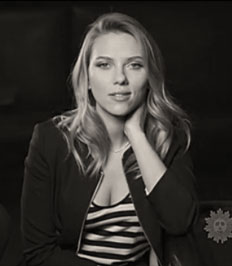
January 13, 2013 – CBSNews.com
Q&A: Scarlett Johansson
CBS News) Scarlett Johansson built a loyal following with roles in movies like 2003's "Lost in Translation," where she starred opposite Bill Murray. The question now is whether all those movie fans will follow her to the Broadway theater. That's where Anthony Mason caught up with her for some Questions and Answers:
Beating up bad guys last summer as the Black Widow was part of a career transition for one of Hollywood's greatest sex symbols. The next step will take Scarlett Johansson from the sound stage to the Broadway stage:
"Sometimes you wander around the theater to think?" Mason asked.
"Well, I like to be on the stage when there's nobody out there," she replied.
For the next two-and-a-half months she'll be at the Richard Rodgers Theatre. "It's a beautiful theater," Johansson said. "You know, I don't really spend a lot of time in the house. I like to be up there."
Scarlett Johansson stars a Maggie in a revival of Tennessee Williams' "Cat on a Hot Tin Roof." / CBS News
The 28-year-old actress is taking on one of theatre's classic roles: Maggie in Tennessee Williams' "Cat on a Hot Tin Roof."
"Even after I was committed to doing it, it weighed on me like a ball and chain," Johansson said. She said what attracted her to the part was "that it was terrifyingly challenging, and I didn't know how to do it."
But eager to move beyond the ingenue roles that made her a movie star, Johansson has taken on the part of an ambitious Southern belle trying to hold onto her decaying marriage.
"It is intense. But it's liberating."
Johansson reportedly is earning $40,000 a week plus a percentage of the box office - which means the show needs to sell a lot of tickets.
Johansson read the sign in the lobby: "This performance is sold out. But unfortunately, it's facing us."
"What's it say on the other side?" Mason asked.
"Yeah, it's like free tickets."
Even in previews, her name on the marquee has made "Cat" one of the hottest tickets on Broadway.
"Your fame means that your name has been reduced to acronym that everybody uses."
"That's terrible," she laughed. "It's so terrible. I hate that name. It's so crazy."
"Does anybody call you ScarJo at home?" Mason asked.
"No! No. Hopefully it's gonna go away sometime."
This is not Johansson's first appearance on Broadway. In 2010 she won a Tony Award for her performance in Arthur Miller's "A View From the Bridge."
"I read that after that play you said to yourself, 'I'm not going to do another play,'" Mason said.
"I think it's kind of what I imagine it must be like to give childbirth, and you sort of forget all the pain," she laughed. "You just remember this beautiful prize you hold."
CREATIVE CAST
-
TENNESSEE WILLIAMS (Playwright)
Two-time Pulitzer Prize-winning writer Tennessee Williams is one of America's greatest playwrights. His plays include The Glass Menagerie, A Streetcar Named Desire and The Night of the Iguana among other celebrated works. In addition to twenty-five full-length plays, Williams produced dozens of short plays and screenplays, two novels, a novella, sixty short stories, over one hundred poems, and an autobiography. His works have been translated into at least twenty-seven languages, and countless productions of his work have been staged around the world.
-
ROB ASHFORD (Director)
Rob Ashford is an American director and choreographer who works extensively on Broadway and in London's West End. As an Associate Director for London's Donmar Warehouse, Rob's productions include Anna Christie starring Jude Law and Ruth Wilson (Olivier Award for Best Revival), A Streetcar Named Desire starring Rachel Weisz (Olivier nomination) and Parade (Olivier nominations for Direction and Choreography). In New York, he is currently represented by Evita for which he provided the choreography (Tony, Drama Desk, Outer Critics Circle, Astaire nominations). He directed and choreographed How to Succeed in Business starring Daniel Radcliffe (Tony nominations for Direction and Choreography) and Promises, Promises starring Sean Hayes and Kristen Chenowith (Tony nomination for Choreography). He choreographed Cry Baby (Drama Desk, Outer Critics and Astaire Awards, Tony nomination), Curtains (Tony nomination), The Wedding Singer (Tony nomination), and Thoroughly Modern Millie (Tony Award for Best Choreography). Other London credits include Shrek (Co Director), Evita (Olivier nomination), Guys and Dolls (Olivier nomination), Thoroughly Modern Millie (Olivier nomination), and Forum (National Theatre). He recently directed the World Premier of the new musical Finding Wonderland produced by Harvey Weinstein at The Curve Theatre in Leicester. He choreographed Candide which played at The ENO in London, La Scala in Milan, and The Chatelet in Paris. He won an Emmy Award for his choreography for the 81st Academy Awards and has staged tributes for Meryl Streep, Barbara Cook, Jerry Herman, Barbra Streisand and Andrew Lloyd Webber for The Kennedy Center Honors. He did the choreography for the film Beyond the Sea directed by and starring Kevin Spacey. He is on The Board of Trustees for The Joyce Theatre, The Executive Board of SDC, and is an Associate Director of The Old Vic in London.
-
CHRISTOPHER ORAM (Scenic Designer)
Recipient of Tony, Olivier, Evening Standard, Critics Circle, Garland and Ovation awards for his work both here in the U.S. and in the U.K. His most recent work on Broadway includes the scenic and costume designs for Evita and the Donmar Warehouse productions of Red, Hamlet with Jude Law and Frost/Nixon. Also, King Lear with Derek Jacobi (BAM).
-
JULIE WEISS (Costume Design)
Broadway: The Elephant Man (Tony nom.), Piaf, Macbeth. TV: “The Dollmaker” (Emmy Award), “Little Gloria…Happy at Last” (Emmy nom.), “Evergreen” (Emmy nom.), “Mrs. Harris” (Emmy nom.), “A Woman of Independent Means” (Emmy Award). Film: American Beauty (Costume Designers Guild Award), Fear and Loathing in Las Vegas, Steel Magnolias, F/X, Hollywoodland, Searching for Bobby Fischer, Honeymoon in Vegas, A Simple Plan, Get Low, Twelve Monkeys (Academy Award nom.), The Ring, Frida (Academy Award nom.), Bobby, Auto Focus, Secretariat (Diane Lane), No Strings Attached, Blades of Glory (Costume Designers Guild Award), HBO’s Criminal Justice, Hitchcock. Julie was also the recipient of the Costume Designers Guild’s award for career achievement.
-
NEIL AUSTIN (Lighting Designer)
Recipient of the 2010 Tony and Drama Desk Awards for Red and the 2011 Laurence Olivier Award for The White Guard at the National Theatre, London. Previous Broadway credits include Evita (Marquis), Red(Golden), Hamlet (Broadhurst), The Seafarer (Booth), Frost/Nixon (Jacobs). Other U.S. credits include King Lear with Derek Jacobi and The Seagull and King Lear with Ian McKellen (BAM), Red and Parade (Taper Forum, Los Angeles), Madame Butterfly (Houston Grand Opera), Frost/Nixon (U.S. national tour). Previously with Rob Ashford: Finding Neverland (Leicester), A Streetcar Named Desire and Parade (Donmar Warehouse). Other theatre: extensive credits in the U.K. for the National Theatre, Donmar Warehouse, Royal Opera House, Royal Shakespeare Company and in the West End.
-
ADAM CORK (Composer and Sound Design)
Adam Cork is the co-lyricist and composer of the documentary musical London Road (National Theatre Olivier, Critics’ Circle Award, Best Musical 2011). Other work includes Anna Christie (Donmar, Evening Standard Award 2011); King Lear (Donmar, Olivier Award 2011); Red (Donmar/Broadway, Tony Award 2010); Enron (Tony nominations 2010 for Best Score and Best Sound); Romeo and Juliet (RSC/Armory 2010-11); Hamlet (Donmar/Broadway 2009); Phedre (NT/Washington); Macbeth (Chichester/Broadway, Tony nomination 2008); Frost/Nixon (Donmar/Broadway 2007); A Streetcar Named Desire, The Chalk Garden, Othello(Donmar); The Last Days of Judas Iscariot (Almeida). Screen work includes scores for The Hollow Crown, series titles and Richard II (Neal Street/NBC/WNET/BBC 2012); Macbeth (BBC 2010).
-
PAUL HUNTLEY (Wig and Hair Design)
London-born Paul Huntley has worked on hundreds of Broadway shows since his 1972 arrival in New York, most memorably the original productions of Amadeus, Cats, Evita, Les Misérables, Sweeney Todd, The Producers and Hairspray. A recipient of Drama Desk and Tony Awards, he has also worked with the some of the most legendary leading ladies of the cinema, ranging from Bette Davis, Mae West, Marlene Dietrich and Vivien Leigh to Jane Fonda, Faye Dunaway, Glenn Close and Jessica Lange. Current shows include War Horse, Chaplin and Nice Work If You Can Get It.
-
RICK SORDELET (Fight Director)
Broadway: 56 Broadway shows including The Lion King, Beauty and the Beast, also the National Tours of Beauty and the Beast, and Les Miz. International: 53 First Class productions worldwide: including Ben Hur Live in Rome and European Tour. Opera: Cyrano (starring Placido Domingo) at the Metropolitan Opera, The Royal Opera House and La Scalla, in Milan. Don Carlo directed by Nicholas Hytner at the MET, and Heart of the Soldier, a new Opera at San Francisco Opera. Television: Stunt Coordinator for “Guiding Light” for 12 years. “One Life to Live”. Instructor: Yale School of Drama. Affiliations: Board member for the Shakespeare Theatre of New Jersey. Awards: Edith Oliver Award for Sustained Excellence from the Lucille Lortel Off-Broadway League, Jeff Award for Best Fight Direction for Romeo and Juliet at Chicago Shakespeare Theater.
-
ANGELINA AVALLONE (Makeup Design)
Broadway: Nice Work If You Can Get It, The Mystery of Edwin Drood, Chaplin, An Enemy of the People, The Anarchist, Scandalous, Golden Boy, Golden Age, Venus in Fur, Anything Goes, Rock of Ages, Memphis, Other Desert Cities, The Best Man, The Addams Family, The Importance of Being Earnest, Leap of Faith, Sunday in the Park With George, A Little Night Music, Bye Bye Birdie, The Little Mermaid, The Color Purple, Chitty Chitty Bang Bang, Gypsy, Young Frankenstein, The Light in the Piazza.
OTHER REVIEWS
Cat on a Hot Tin Roof – review
***/5 /www.theguardian.com

Almost purr-fect … Scarlett Johansson as Maggie the Cat in Cat On a Hot Tin Roof. Photograph: Joan Marcus/AP/Boneau/Bryan-Brown
Does Broadway need another revival of Tennessee Williams's Cat On a Hot Tin Roof, its third in three years? Perhaps not. But when an actor such as Scarlett Johansson gets her claws into a part like Maggie, the Cat gets another life. Sinuous in a beige slip, with head swathed in a marmalade wig, eyes opulently lined in black, Johansson should get plenty of audience members purring. But despite these charms, director Rob Ashford's production is little more than a star vehicle, erratically driven.
With curtains adorned with a pattern of lowering branches and a burst of ominous strings as the house lights dim, the evening promises southern gothic, but devolves into a mix of naturalism and farce. (For some reason Ashford insists on having characters chase each other around and around the bed.) As in the recent revival of Glengarry Glen Ross with Al Pacino, the actors all seem to be inhabiting different plays, to say nothing of different regions. Some actors luxuriate in the Mississippi vowels while others, such as Debra Monk's Big Mama, decline to offer any discernible accent at all.
The play is set, famously, during a muggy evening on the Pollitt plantation in the Mississippi Delta. The occasion is the 65th birthday of Big Daddy (Ciarán Hinds) and while cancer means he likely won't see another, the family has gathered to celebrate. The elder son Gooper, his grasping wife Mae and their five children (whom Maggie refers to memorably as "no-neck monsters", though Ashford has cast rather slim tots) do everything but wrest the plantation deed from Daddy's dying hand. Meanwhile, younger song Brick (Benjamin Walker) consistently ignores the festivities in favour of the depths of a whiskey bottle, even as his wife Maggie (Johansson) urges him to take an interest in his inheritance.
Brick refuses to sleep with Maggie, believing her to be partially responsible for the death of his best friend, Skipper, who may have loved Brick in a more than friendly way. Resisting the charms of Johansson should indicate a bravura performance, but Walker, a rambunctious delight in Bloody Bloody Andrew Jackson, seems oddly passive here. Johansson, on the other hand, is very active and sometimes very good. She looks terrific (if there were an award for foundation garments hers would take the trophy) and she has emphasised her natural huskiness to deliver lines in a seductive growl. As in her Broadway debut in A View from the Bridge, she likes to let the audience know how hard she's working and some scenes seem more studied than lived, though she has a very fine last act. But all her feline grace and neat red claws still can't make this revival land on its feet.
Scarlett Johansson in Cat on a Hot Tin Roof, Richard Rodgers Theatre, New York, review
Audiences will not be disappointed by Scarlett Johansson's return to the stage in Cat on a Hot Tin Roof, writes Mark Hughes.
****/5 By Mark Hughes /GMT 18 Jan 2013 / www.telegraph.co.uk
Scarlett Johansson’s performance as Maggie, the lead in Tennessee Williams’s Cat on a Hot Tin Roof, marks her return to the theatre following her widely acclaimed Broadway debut in Arthur Miller’s A View from the Bridge – and she could barely have chosen a more challenging role. The first half-hour of the three-hour play is almost solely reliant on long monologues from Maggie, with only the briefest of interruptions from her husband Brick (Benjamin Walker).
What’s more, comparisons with the most famous incumbent of that character are inevitable. Like Elizabeth Taylor, Johansson is a former child actress who tentatively moved into adult roles before taking the big screen by storm and becoming one of Hollywood’s leading sex symbols. And like Taylor, who was 25 when she took the role of Maggie opposite Paul Newman in the 1958 film, Johansson (28) delivered a charismatic, if at times slightly breathless, performance.
Affecting a very passable Southern accent, her Maggie flits between rage at the fact her husband no longer seems even to like her, and sorrow that she cannot force him to. In between, there are moments of genuine comedy that drew loud laughs and applause. One wonders, though, how her vocal cords will hold up during the 15-week run – at times, she seemed on the verge of losing her famously husky voice.

Benjamin Walker and Scarlett Johansson in Cat on a Hot Tin Roof. ©2012 Joan Marcus
All the play’s action is set in one room: Maggie and Brick’s bedroom. Throughout the three acts, various family members enter, to discuss the play’s intertwined plot threads, including the fact that Brick’s father, Big Daddy, is dying of cancer but does not yet know it, and Brick’s battle with alcoholism, brought on by feelings of guilt over the death of his best friend Skipper. Vital, too, is Brick’s anger towards his wife Maggie.
Mercifully for Johansson, Maggie is barely in the second act, even if the play is slightly less engaging for her absence. Instead it features Brick and his father, engaged in a lengthy discussion, which at times leaves the drama feeling slightly one-note. Although this is compounded by the unchanging set and costumes, the introduction of Irish actor Ciaran Hinds – giving a colossal performance as Big Daddy – certainly helps spice thing up.
Walker is the one actor who remains on stage at all times – albeit often in silence – and his performance as a weary rather than outright disdainful Brick grows more powerful as the play goes on. Other cast members cast give strong showings. Debra Monk is moving and amusing as Big Mama, while the English actress Emily Bergl is fabulously funny as the jealous and bitchy sister-in-law, Mae – there is no sense of the show hanging entirely upon the Hollywood star at the top of the bill.
Even so, it is Johansson – who spends much of the first act of the play dressed in nothing but a slip – whom the audiences will flock to see. And they will not be disappointed.
Cat on a Hot Tin Roof: Theater Review
1/17/2013 by David Rooney / www.hollywoodreporter.com
Scarlett Johansson, Ciaran Hinds, Benjamin Walker and Debra Monk star in Broadway's third revival in a decade of Tennessee Williams' 1955 drama of greed, mendacity and death.
NEW YORK – Somebody spayed the cat. And it wasn’t the hardworking main attraction Scarlett Johansson, who plays Tennessee Williams’ tenacious feline title character in Cat on a Hot Tin Roof. The star and her similarly marooned fellow castmembers are all at the mercy of Rob Ashford, a director out of his depth and reaching for any floatation device he can grab in this sinking Broadway revival, which manages to be both thunderously emphatic and curiously flat.
Choreographer-turned-director Ashford has staged Broadway revivals of the musicals Promises, Promises and How to Succeed in Business Without Really Trying. His forays into directing drama have been in acclaimed London productions of Williams’ A Streetcar Named Desire (with Rachel Weisz) and Eugene O’Neill’s Anna Christie (with Jude Law). But, the reception for those outings notwithstanding, there’s little evidence here that he knows what he’s doing.

Paradoxically, for someone whose theater experience is rooted in dance, Ashford displays a tin ear for the vigorous musicality of Williams’ flavorful dialogue. The actors are directed to shout or mumble, with the production’s cluttered audio wallpaper forcing them to compete against busy sound and music cues. As a result, the humor often doesn’t land and the dramatic peaks tend to fly by unnoticed.
Lest the subtext should breeze over someone’s head, every bit of key dialogue is underlined with a sonic mallet. A mention of glory days on the football field prompts the eerie echo of a cheering crowd. Recollections of more carefree times are underscored with a tinkling "By the Light of the Silvery Moon." Talk of a fateful phone call triggers a ghostly ringing. And when death comes a calling, the field hands are at the ready offstage to spark up a mournful spiritual. The play’s birthday fireworks are used with the bluntness of punctuation, and as for the Act III storm … whoa there! Usually when the heavens rumble and the gauze curtains billow like this, some undead cad is chomping on the neck of a virgin.
According to reports out of previews, Ashford experimented with having a spectral version of Skipper prowl the stage. That device imposed a vivid embodiment of the football buddy whose death haunts former golden boy Brick Pollitt (Benjamin Walker), forcing him to seek refuge in vast quantities of bourbon. Thankfully, the idea was abandoned, though there are few other signs of restraint. It’s clear that Ashford doesn’t trust the play to work without a lot of intrusive directorial flourishes.
Even the set by gifted designer Christopher Oram is heavy-handed, if quite strikingly so in its washed-out Southern decadence. With a tonal palette ranging from beige to gray, this is a cavernous mausoleum, drenched in Neil Austin’s sepulchral lighting and ominous shadows, which pour in through those aforementioned drapes. Got it. We’re in a place of death. And in case the sexual wasteland that defines the union of Maggie (Johansson) and Brick is unclear, their loveless marital bed stands like a monolith, smack in the middle of the stage. Poor Walker is forced to hobble around it on Brick’s broken ankle like a lame greyhound looping the track
For an actor whose experience is primarily in film, Johansson has innate stage presence, as she showed in her Tony-winning turn opposite Liev Schreiber in A View From the Bridge in 2010. She has no trouble playing sultry and looks alluring in Maggie’s iconic slip. Johansson has made some bold choices in the demanding role, aging herself with a coarsened, growling voice, knowing humor and a refusal to soften the character’s abrasive edge. There’s no kitten in her cat. But keeping Maggie’s vulnerability hidden until the final act seems a mistake. Without the underlying wounds she’s just a shrew.
Many actresses in the part use defiant pride as a means of backing up the massive lie that Maggie tells to secure Brick’s claim on his dying father’s estate. Instead Johansson trembles with the terror of exposure. But there’s otherwise insufficient delicacy in her characterization, which overall is the problem with Ashford’s production.
The first act in particular lumbers along, with Walker mostly seeming as uninterested as Brick is in the prolonged assault of seduction and supplication launched by Maggie, the wife he can no longer stand to see or hear. He fires up only momentarily, and then more consistently in Act II. That’s when Brick is forced into a confrontation with his father Big Daddy (Ciaran Hinds), the blowhard Mississippi Delta plantation owner, kept in the dark about his cancer diagnosis. Walker is at his best showing Brick’s furious defensiveness whenever his wife or father picks at the open wound of Skipper’s death and the ambiguities of their relationship.
There are real sparks in the father-son faceoff because Hinds gets the determination and frustration of Big Daddy, a crude man accustomed to buying or bullying his way out of any situation. It’s a cruel irony that the exception is self-destructive Brick, the only member of the family he truly loves. Ashford and his actors do right by this sometimes-neglected aspect of the play, forging a kinship that exists between the two characters contrary to all logic.
Hinds conveys the hardness of Big Daddy, especially in his cold dismissal of his devoted wife Big Mama (Debra Monk). But in a role that can be shattering, Monk’s performance gets lost. Her moments of hurt, bewilderment and anger mostly dissolve in the stormy air or are steamrolled by Ashford’s bag of tricks. As Brick’s vulture-like brother and sister-in-law, Gooper and Mae, Michael Park and Emily Bergl hit the required notes of unctuousness and avarice. But here, too, some of the caustic wit that runs through this play about greed, lies and death is missing, along with the pathos.
Williams’ 1955 Pulitzer winner has not exactly been neglected on Broadway, this being its third revival in a decade. It’s arguable whether this staging hits fewer or more of the right notes than the handsome but unbalanced 2003 production, in which Ashley Judd and Jason Patric were seriously outclassed by Ned Beatty and Margo Martindale in the senior roles. Or the 2008 all-black staging, where Terrence Howard, Anika Noni Rose, James Earl Jonesand Phylicia Rashad crackled with life despite the inconsistencies of Debbie Allen’s direction. For an American classic, this is a surprisingly tough work to conquer.
Either way, it’s sad to think that audiences experiencing the play for the first time in this laborious version might be inclined to question its stature.
Venue: Richard Rodgers Theatre, New York (runs through March 30)
Cast: Scarlett Johansson, Ciaran Hinds, Benjamin Walker, Debra Monk, Emily Bergl, Michael Parks, Vin Knight, Brian Reddy, Jordan Dean, Tanya Birl, Will Cobbs, Lance Roberts, Cherene Snow, Laurel Griggs, Victoria Leigh, Charlotte Rose Masi, George Porteous, Noah Unger
Director: Rob Ashford
Playwright: Tennessee Williams
Set designer: Christopher Oram
Costume designer: Julie Weiss
Lighting designer: Neil Austin
Music & sound designer: Adam Cork
Presented by Stuart Thompson, Jon B. Platt, The Araca Group, Roger Berlind, Scott M. Delman, Roy Furman, Ruth Hendel, Carl Moellenberg, Scott & Brian Zeilinger, Nederlander Presentations, Tulchin/Bartner Productions, Scott Rudin

More Background On CatOnAHotTinRoofBroadway.com
CatOnAHotTinRoofBroadway.com is associated with the 2013 Broadway revival of Tennessee Williams’s Cat on a Hot Tin Roof, a star-driven production headlined by Scarlett Johansson as Maggie and Benjamin Walker as Brick. Presented at New York City's Richard Rodgers Theatre, the limited engagement brought one of the most famous American dramas of the 20th century back to Broadway with a prominent cast, an experienced creative team and considerable media attention.
The website functioned as the online home for the production, providing theatergoers with information about the play, its cast and creative personnel, press coverage and critical reaction. Today, its greatest interest is historical. It preserves a window into the way a major Broadway production was promoted during the early 2010s, when official show websites had become an important bridge between traditional theatrical advertising and online ticket marketing.
The revival began previews on December 18, 2012, officially opened January 17, 2013, and concluded its scheduled limited engagement on March 30. It played 34 previews and 84 regular performances.
Although the production received sharply divided reviews, it attracted substantial attention because Johansson was returning to Broadway after her Tony Award-winning performance in A View From the Bridge. Her celebrity helped transform a revival of a nearly 60-year-old play into one of the more visible theatrical events of the 2012-2013 Broadway season.
The Play Behind the Website
Cat on a Hot Tin Roof was written by Tennessee Williams and first produced on Broadway in 1955. Set on a wealthy Mississippi Delta plantation, the drama revolves around the Pollitt family as it gathers for the 65th birthday of its patriarch, Big Daddy.
Beneath the birthday celebration is a crisis. Big Daddy is gravely ill, although he has initially been led to believe otherwise. His impending death raises questions about inheritance, family loyalty and control of his estate.
At the center of the drama are Big Daddy's younger son, Brick, and Brick's wife, Maggie. Brick is a former athlete who has withdrawn emotionally from his wife and increasingly depends on alcohol. He remains haunted by the death of his close friend Skipper and by questions surrounding the nature of their relationship. Maggie, meanwhile, desperately attempts to save both her marriage and the couple's position within the Pollitt family.
Williams uses this family confrontation to explore subjects that were unusually provocative when the play premiered: sexual repression, homosexuality and its social stigma, alcoholism, infertility, greed, mortality, marital alienation and the lies people tell themselves and one another.
One word repeatedly becomes central to the drama: "mendacity." The inability—or unwillingness—of the characters to confront uncomfortable truths is one of the reasons the play has remained relevant through generations of productions.
Tennessee Williams and an American Theatrical Landmark
The cultural importance of the 2013 production cannot be understood without considering the stature of the play itself.
Cat on a Hot Tin Roof won the 1955 Pulitzer Prize for Drama and the New York Drama Critics' Circle Award for Best American Play. Its original Broadway production opened at the Morosco Theatre on March 24, 1955, and ran for 694 performances.
The original production was directed by Elia Kazan and starred Barbara Bel Geddes as Maggie, Ben Gazzara as Brick and Burl Ives as Big Daddy. Kazan's involvement was particularly important because the director and Williams wrestled with aspects of the play's final act, contributing to a long-running scholarly and theatrical discussion about different versions of the ending.
The play quickly became part of the American theatrical canon.
Its fame expanded dramatically with the 1958 film starring Elizabeth Taylor as Maggie, Paul Newman as Brick and Burl Ives recreating his role as Big Daddy. The film received six Academy Award nominations, including Best Picture and acting nominations for Taylor and Newman.
Consequently, every major revival confronts an unusual challenge: audiences may already have strong ideas about Maggie, Brick and Big Daddy before the curtain rises.
Scarlett Johansson as Maggie the Cat
The defining commercial feature of the 2013 production was Scarlett Johansson.
Johansson was already an internationally recognized film star, with credits including Lost in Translation, Girl with a Pearl Earring, The Prestige and The Avengers. Yet she was not simply a movie celebrity making an experimental appearance onstage.
Three years earlier, Johansson had made her Broadway debut in Arthur Miller's A View From the Bridge. Her performance earned her the 2010 Tony Award for Best Performance by a Featured Actress in a Play.
That achievement changed expectations surrounding her casting as Maggie. Rather than asking only whether a Hollywood star could handle Broadway, critics were evaluating the second Broadway appearance of an actress who had already won theater's most prominent American acting award.
Maggie is also a formidable role. Much of the first act depends upon her, including extended stretches in which she tries to provoke, seduce, reason with and emotionally penetrate Brick while he largely resists her.
Johansson was only 28 during the production, close to the age at which Elizabeth Taylor had played Maggie in the famous film. The comparison inevitably became part of the surrounding publicity.
Vogue devoted significant coverage to the production, including a feature photographed by Annie Leibovitz pairing Johansson and Walker. CBS News interviewed Johansson shortly before opening, discussing both the difficulty of the role and whether her enormous movie following would translate into Broadway ticket buyers.
It largely did.
Benjamin Walker as Brick
Opposite Johansson was Benjamin Walker as Brick Pollitt.
Walker already had substantial theatrical credentials. He was especially associated with the title role in the Broadway musical Bloody Bloody Andrew Jackson, in which his energetic and unconventional performance helped establish him as a distinctive stage presence.
Brick demanded something very different.
For much of Cat on a Hot Tin Roof, Brick is deliberately withdrawn. He drinks, resists Maggie, avoids emotional confrontation and waits for the "click" that he believes alcohol will provide—the moment when his mind becomes peaceful.
The role therefore requires an actor to communicate considerable internal turmoil while frequently appearing passive.
Walker also spent much of the production moving with crutches because Brick has injured his ankle. The combination of limited physical mobility, long stretches of listening and the character's emotional repression makes Brick deceptively difficult to play.
The production's second act gave Walker his most substantial confrontation when Brick and Big Daddy engage in an extended father-son reckoning over alcoholism, sexuality, death, family expectations and truth.
Ciarán Hinds, Debra Monk and the Supporting Cast
Ciarán Hinds played Big Daddy.
Already respected for extensive stage and screen work, Hinds brought considerable physical and vocal force to the role of the wealthy plantation owner. Big Daddy is crude, domineering and accustomed to exercising authority, but his relationship with Brick exposes emotional vulnerabilities beneath that power.
Debra Monk played Big Mama. A Tony and Emmy Award winner, Monk portrayed a woman simultaneously devoted to her husband and wounded by his dismissiveness toward her.
Emily Bergl played Mae, while Michael Park portrayed Gooper, Brick's older brother. Mae and Gooper form the competing branch of the Pollitt family, acutely aware that Big Daddy's death could determine the distribution of his fortune.
The company also included numerous supporting performers and child actors representing the sprawling Pollitt household.
The result was an ensemble surrounding the four marquee performers rather than a production dependent solely on Johansson, even though her celebrity inevitably dominated advertising and media attention.
Rob Ashford's Direction
The production was directed by Rob Ashford, whose career had encompassed both choreography and directing.
Ashford won a Tony Award for choreographing Thoroughly Modern Millie and had worked on major Broadway productions including How to Succeed in Business Without Really Trying, Promises, Promises and Evita. In London, his directing work included A Streetcar Named Desire and an acclaimed production of Eugene O'Neill's Anna Christie.
His staging of Cat on a Hot Tin Roof nevertheless became one of the most controversial elements of the 2013 revival.
During previews, the production experimented with physically representing the deceased Skipper onstage as a ghostlike presence. Jordan Dean appeared as "Ghost Skipper," externalizing a character who normally exists only through memories and conversation.
The device was eliminated before the production settled into its final form.
That decision is revealing. Skipper's absence is fundamental to Williams's play: the audience is forced to reconstruct him through conflicting recollections and implications. Making him physically visible altered that ambiguity. Removing the character restored the sense that Brick, Maggie and the audience are all grappling with someone who can no longer explain himself.
Design and Atmosphere
Christopher Oram designed the scenery. Julie Weiss created the costumes, Neil Austin designed the lighting, and Adam Cork was responsible for music and sound.
The production emphasized the oppressive atmosphere of the Pollitt plantation and the emotional claustrophobia of Maggie and Brick's bedroom. The bed itself became a visually dominant object—a fitting symbol in a drama where the couple's refusal or inability to have sex has enormous emotional and financial consequences.
The design favored faded Southern grandeur rather than a brightly romanticized plantation. Lighting, shadows, curtains and sound contributed to an atmosphere of decay and approaching death.
Critics differed sharply over whether these effects deepened Williams's drama or overwhelmed it.
Some particularly objected to prominent sound cues and other directorial flourishes that seemed to emphasize emotions already apparent in Williams's language. Others found considerable theatrical power in the production despite its excesses.
Richard Rodgers Theatre and Its Broadway Location
The production played at the Richard Rodgers Theatre at 226 West 46th Street in Manhattan, between Broadway and Eighth Avenue.
This placed Cat on a Hot Tin Roof directly within New York's Theater District, close to Times Square and surrounded by Broadway houses, restaurants, hotels and other tourist destinations. The location made the production easily accessible to both local theatergoers and visitors.
The Richard Rodgers Theatre has a long Broadway history. Originally opened in 1925 as Chanin's 46th Street Theatre, it was later known as the 46th Street Theatre before being renamed for composer Richard Rodgers in 1990.
Its later association with Hamilton has made the theater even more internationally recognizable, but decades before that phenomenon it had already hosted numerous important Broadway productions.
For Cat on a Hot Tin Roof, the theater provided approximately 1,380 seats, making the production a substantial commercial undertaking rather than an intimate limited-run drama.
Producers and Commercial Organization
The 2013 revival was produced by an extensive group of established Broadway producers and theatrical organizations.
The producing roster included Stuart Thompson, Jon B. Platt, The Araca Group, Roger Berlind, Scott M. Delman, Roy Furman, Ruth Hendel, Carl Moellenberg, Scott and Brian Zeilinger, Nederlander Presentations, Tulchin/Bartner Productions and Scott Rudin, with Kevin Emrick credited as an associate producer.
This was therefore a major commercial Broadway production backed by people and organizations with substantial experience in theatrical financing, management and production.
The Richard Rodgers Theatre itself was operated by the Nederlander Organization.
CatOnAHotTinRoofBroadway.com should be understood in that commercial context. Its original role was not that of an independent Tennessee Williams reference site. It was the promotional web identity attached to a specific Broadway revival, supporting the production's marketing and providing audiences with information about the show.
Popularity, Attendance and Broadway Grosses
The production's commercial statistics help put its popularity into perspective.
Playbill's historical production data reports approximately $11.66 million in total grosses when the preview period and complete engagement are included. Its highest reported weekly gross was $966,948 during the week ending December 30, 2012. The average paid ticket price across the complete engagement was approximately $97, and average attendance was about 74 percent of capacity.
Different Broadway databases can show lower calendar-year totals because performances in December 2012 fall outside their 2013 calculations. BroadwayWorld's 2013-only figures, for example, record roughly $9.85 million in grosses and more than 102,000 admissions during the 2013 portion of the run.
The production's attendance fluctuated substantially.
During the week containing its official opening, it played to more than 90 percent of capacity. The week ending February 17 produced approximately $958,000 in grosses and nearly 80 percent attendance. Other weeks dropped into the 60-percent range.
These numbers suggest a production with significant public interest and strong star appeal, but not a runaway sellout throughout its entire engagement.
Importantly, it was always scheduled as a limited engagement. It closed March 30, 2013, after 15 weeks, with 34 previews and 84 regular performances. At closing, representatives did not publicly confirm whether the production had recouped its capitalization.
Critical Reception
Reviews were notably mixed.
Johansson generally received more favorable notices than the production surrounding her.
Ben Brantley's New York Times assessment found imperfections in her interpretation of Maggie but regarded her as a stage performer of formidable presence and intelligence. Vogue was considerably more enthusiastic, while the New York Post described her performance in strongly favorable terms.
The Guardian gave the production three stars out of five. Its review praised aspects of Johansson's work but argued that Ashford's production functioned too much as an inconsistently handled star vehicle.
The Telegraph was more positive, awarding four stars and emphasizing the difficulty of Maggie's role, Johansson's charisma and strong contributions from Hinds, Walker, Monk and Bergl.
The Hollywood Reporter delivered one of the harshest assessments. Its criticism focused primarily on Ashford's direction, particularly intrusive sound, music and staging devices that it felt interfered with the rhythms of Williams's writing. At the same time, the review acknowledged Johansson's stage presence and found significant power in the confrontation between Walker's Brick and Hinds's Big Daddy.
This division is useful when assessing the revival historically. It was not a universally acclaimed landmark interpretation of Cat on a Hot Tin Roof. Rather, it was a high-profile, ambitious and much-discussed production whose central actress was often regarded as more successful than the overall staging.
BroadwayWorld's aggregation of contemporary criticism similarly reflects a mixed critical consensus.
Awards and Recognition
Unlike several earlier Broadway productions of Cat on a Hot Tin Roof, the 2013 revival did not become a major Tony Awards contender.
Scarlett Johansson did, however, receive a 2013 Drama League Distinguished Performance Award nomination for her portrayal of Maggie.
The contrast with the play's broader awards history is notable.
The original Cat on a Hot Tin Roof won the Pulitzer Prize for Drama and New York Drama Critics' Circle Award and received multiple Tony nominations. Later Broadway revivals also produced prominent nominations and awards. Charles Durning, for example, won the 1990 Tony Award for his performance as Big Daddy.
Johansson herself entered the 2013 production already possessing a Tony Award from A View From the Bridge.
Thus, even without a large collection of new awards, the revival was surrounded by award-winning talent and belonged to a theatrical lineage stretching back nearly six decades.
Press and Media Coverage
One of the production's clearest measures of cultural visibility was the breadth of its media coverage.
This was not a revival discussed only in specialist theater publications.
Vogue featured Johansson and Walker before opening and later reviewed the production. CBS News interviewed Johansson. The New York Times, New York Post, Los Angeles Times, Financial Times, USA Today, Bloomberg, The Guardian, The Telegraph, The Hollywood Reporter, Variety, Broadway.com, Playbill and numerous other outlets covered or reviewed the production.
The press interest illustrates the marketing advantage of casting a globally recognizable movie star in a classic Broadway play.
Johansson created a crossover audience. Readers who might not routinely follow Broadway news nevertheless knew her from films, while serious theater audiences were curious whether her Tony-winning debut had represented a one-time achievement or the beginning of a sustained stage career.
The Website's Likely Audience and Purpose
CatOnAHotTinRoofBroadway.com served several overlapping audiences.
The most immediate audience consisted of potential ticket buyers looking for information about the current Broadway production. Another group consisted of Johansson fans who might be considering Broadway specifically because she was appearing in the show.
The site also appealed to traditional theatergoers interested in Tennessee Williams, Benjamin Walker, Ciarán Hinds, Debra Monk or Rob Ashford.
Its promotional material emphasized recognizable credentials: Johansson's Tony Award, Williams's Pulitzer Prize, Ashford's Broadway and West End experience and the extensive accomplishments of the creative team.
Press quotations served an equally important purpose. Favorable excerpts could be extracted from a mixed body of reviews and transformed into concise endorsements suitable for advertising.
This practice is standard Broadway marketing, but preserved websites are particularly useful because they show which critical comments producers chose to emphasize.
The Revival in the History of Cat on a Hot Tin Roof
By 2013, Cat on a Hot Tin Roof had already returned to Broadway repeatedly.
After the 1955 original came revivals in 1974, 1990, 2003 and 2008. The 2008 production was particularly culturally significant because director Debbie Allen assembled an all-Black cast headed by Terrence Howard, Anika Noni Rose, James Earl Jones and Phylicia Rashad.
The 2013 production was therefore the sixth Broadway staging of the play, counting the original.
This frequency says something important about Williams's durability. Producers repeatedly believe that new actors, directors and generations of audiences can discover something different within the Pollitt family.
Maggie alone has attracted an extraordinary succession of performers. Barbara Bel Geddes originated the role on Broadway. Elizabeth Ashley, Kathleen Turner, Ashley Judd, Anika Noni Rose and Scarlett Johansson subsequently played Maggie in major Broadway revivals, while Elizabeth Taylor made the character internationally famous on film.
Each actress inevitably changes the balance of the play.
The 2013 production's identity was inseparable from Johansson: her combination of movie-star glamour, sexuality, toughness and previously demonstrated theatrical ability made Maggie an unusually logical role for this stage of her career.
Cultural and Social Significance
Cat on a Hot Tin Roof continues to matter because its conflicts extend far beyond the wealthy Southern family depicted onstage.
Brick's grief over Skipper and his inability to discuss their relationship openly reflect the destructive effects of repression. Maggie's struggle exposes the precariousness of marriage, sexuality and economic security. Big Daddy's illness forces the entire family to confront mortality while simultaneously maneuvering for wealth.
Williams also examines masculinity. Brick has been celebrated for athletic achievement and conventional masculine attractiveness, yet he is emotionally paralyzed. Big Daddy embodies a louder, more aggressive form of masculinity based on money, sexual appetite and authority. Neither model produces emotional honesty.
The play's treatment of homosexuality is inseparable from the period in which Williams wrote it. Williams himself was gay, and the coded treatment of Brick and Skipper has generated decades of debate among directors, actors, scholars and audiences.
The famous 1958 film softened this dimension substantially because of Hollywood censorship restrictions of the period. Modern stage productions can engage Williams's sexual subtext far more directly.
That makes every revival partly a conversation between the social conventions of 1955 and those of the era in which the revival is produced.
What CatOnAHotTinRoofBroadway.com Represents Today
CatOnAHotTinRoofBroadway.com is most valuable today as a record of a particular moment in Broadway history.
The 2013 Cat on a Hot Tin Roof existed for only a few months. Sets were dismantled, actors moved to other projects and the Richard Rodgers Theatre welcomed new productions. Yet the web presence associated with the show preserves information that would otherwise be scattered among Playbills, newspaper archives, theater databases and personal memories.
It records a production in which a major Hollywood actress returned to Broadway to tackle one of American drama's most demanding female roles. It documents a prominent director attempting to find a new theatrical language for an extremely familiar play. It also preserves the names of designers, performers and producers whose contributions could easily disappear behind the marquee names.
For researchers, theater fans and people interested in Broadway history, that gives the domain a purpose far beyond its original function as a marketing address.
Legacy of the 2013 Production
The 2013 revival did not replace the original production, the Elizabeth Taylor-Paul Newman film or the acclaimed performances associated with earlier revivals in the cultural memory of Cat on a Hot Tin Roof.
It added another interpretation to them.
Its greatest legacy is arguably Johansson's Maggie. Even critics who objected to Ashford's direction frequently found something substantial in her performance, reinforcing the conclusion established by A View From the Bridge that Johansson was not simply a movie star visiting Broadway.
The production also demonstrated the continuing commercial potential of Tennessee Williams. Nearly six decades after the original Broadway opening, audiences were still willing to pay Broadway prices to spend almost three hours watching the Pollitt family argue about sex, death, money, alcohol, inheritance and truth.
That longevity may be the most important fact surrounding CatOnAHotTinRoofBroadway.com.
The website represents a short-lived Broadway engagement, but the play it promoted has proved anything but short-lived. From its 1955 Pulitzer Prize through repeated Broadway revivals, major international productions and the enduring fame of the 1958 film, Cat on a Hot Tin Roof remains one of the defining works of American theater.
The 2013 revival occupies a distinctive place in that history: a celebrity-driven yet serious attempt to reinterpret Williams for a new generation, anchored by Scarlett Johansson at a pivotal moment in her stage career and preserved online through the domain that once invited audiences to see Maggie, Brick and the Pollitt family confront their secrets once again.
